
What it is
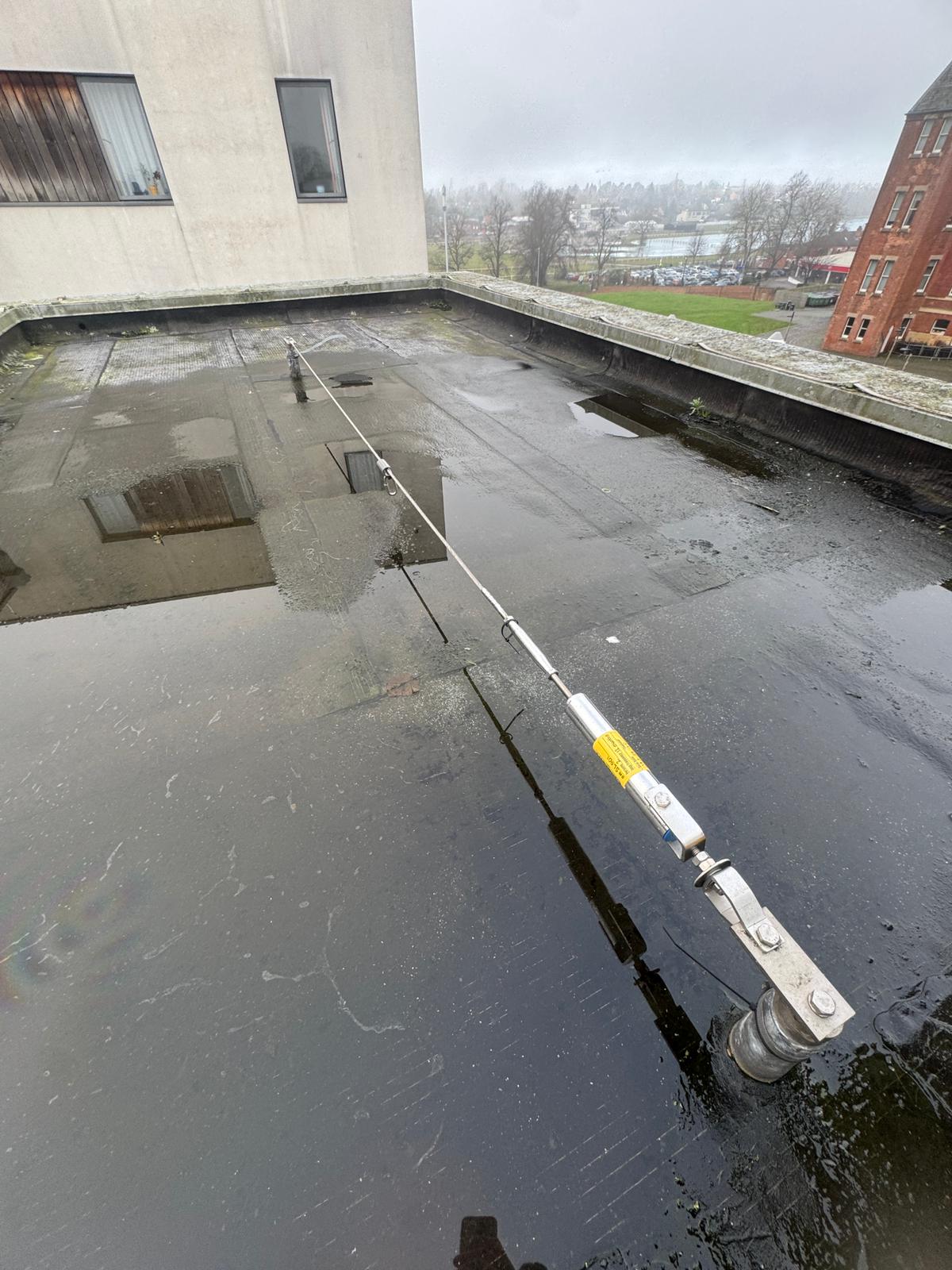
A safety line is a horizontal flexible line, usually a stainless steel cable, tensioned along a roof to provide a continuous anchor point that a user can clip into. This enables users to remain safely attached whilst moving across the roof. They are common on commercial flat roofs, factory roofs, and any building where workers need ongoing access to the full roof area without untethering.
The Work at Height Regulations 2005, BS 7883:2019, and BS EN 365 collectively require that safety line systems are inspected by a competent person at least every twelve months. Most manufacturers — including Latchways, Kee Safety, MSA, and Mansafe — also require annual inspection to maintain warranty cover and product liability. Mansafe is one of several brand names for the same category of safety line system.
The inspection covers the structural anchors at each end, every intermediate post, the cable itself, every shock absorber and tensioner, the cable tension against the manufacturer’s specification, the user shuttle or traveller, and the connecting hardware. Each test point is verified against the specific manufacturer’s installation specification and the current British Standards.
Safety line systems can fail silently. Corrosion at the cable-to-fitting interface, fatigue at intermediate posts, fixings working loose under thermal cycling, and damage from contractors who have used the cable to attach unrelated kit are all common findings. None are visible from ground level. Without a structured annual inspection, the only signal of a failed system is a fall.
The deliverable is a manufacturer-compliant test certificate for each safety line, against BS EN 795 Type C and BS 7883:2019, plus a defect register for any remediation required.
When it applies
For the documentation and inspection questions behind a safety line assessment, read our BS 7883:2019 inspection requirements guide. It explains technical files, legacy installations and conditional pass or fail outcomes.
- Annual recertification, mandatory under BS 7883:2019 for any installed safety line system
- After any fall arrest event (the system must be inspected and recertified before further use)
- On acquisition or change of building ownership
- After roofing work that involved access to the safety line
- After structural work to any fixing point
The process
- System scope. Confirm system type, manufacturer, install date, last test date, and any known issues.
- Site visit. Engineer attends with manufacturer-specific test equipment and access to the roof.
- End-to-end test. Every anchor, post, cable section, tensioner, shock absorber, and traveller inspected and tested. Tension and load-bearing capacity verified against specification.
- Defect logging. Any failures or wear points photographed, located, and assessed against the manufacturer’s repair specification.
- Certification. Test certificate issued within two working days for compliant systems. Defect report and remediation quote for any failures.
What you receive
- Test certificate to BS EN 795 Type C and BS 7883:2019
- Manufacturer-compliant inspection record (Latchways, Kee Safety, MSA, Mansafe, and others)
- Tension reading against specification for every cable section
- Photographic record of every tested point
- Defect register with photographs and locations
- Fixed-price remediation quote for any failed elements
- 12-month recertification reminder