
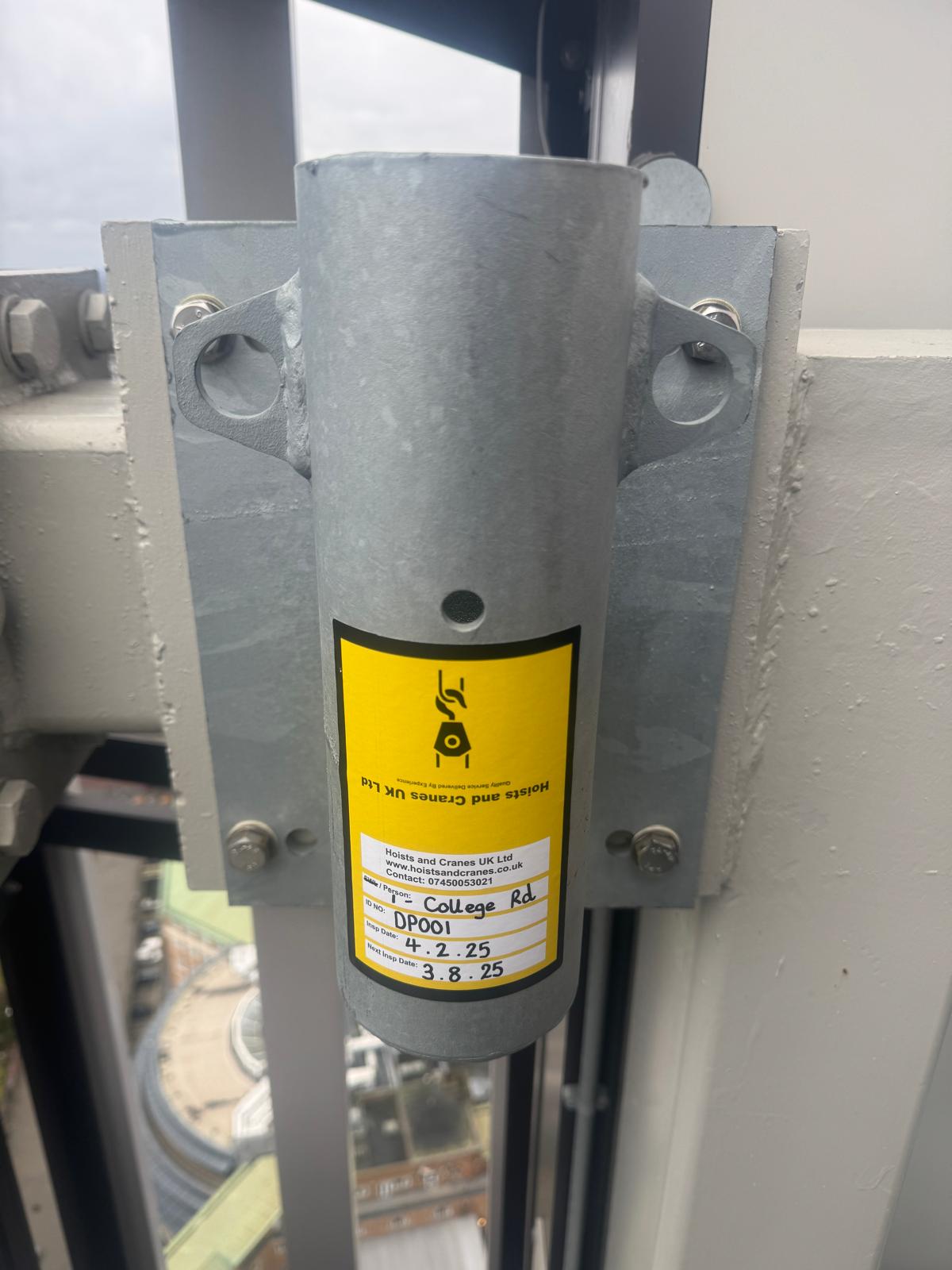
What it is
A davit system is a paired piece of kit: the davit arm itself, and the davit base — the socket, base plate, or counter-balanced mounting — that the arm locates into. A complete installation provides an overhanging anchor point for rope access, rescue work, facade access, or material lifting, with the arm able to be moved between multiple bases distributed around the building. Because the system is used to support the weight of a person at height, it falls under the Lifting Operations and Lifting Equipment Regulations 1998 (LOLER) from the day it is commissioned.
Davit arms are the working arm that extends out over the parapet or facade. The arm is a load-rated lifting appliance in its own right under LOLER. We install the arm, the head fitting, and any extension, articulation, or rotation mechanism, then test it for safe working load and stamp it clearly with its SWL before handover.
Davit bases are the structural mounting the arm sits in or on. They take the form of fixed sockets cast or bolted into the structure, surface-mounted base plates fixed to a parapet or deck, or counter-balanced free-standing bases where structural fixing is not possible. Each base is an anchor device in its own right under BS EN 795 and BS 7985, structurally engineered against the building’s mounting capacity and pull-tested on installation. A complete installation typically distributes multiple bases across a roof or parapet so a single arm can serve different facade elevations.
Installation includes the structural bases, the davit arm itself, the SWL stamping, the LOLER thorough examination record, and the documentation pack for inclusion in the building’s lifting equipment register and anchor register.
When it applies
- New build or refurbishment where rope access or rescue capability is required
- Where existing davit systems have been condemned at thorough examination
- Where a new facade access regime requires lifting capability for materials or persons
- For buildings introducing a routine rescue plan covering a mansafe or rope access system
- Where MEWP access is impractical and rope access with davit support is being introduced
The process
- Site survey. Engineer attends, identifies socket positions, parent material, and structural capacity.
- System design. Socket distribution, davit arm specification, and SWL determined against the operational load case.
- Structural verification. Mounting structure verified for each socket position.
- Quotation. Fixed-price covering design, supply, installation, and the first LOLER thorough examination.
- Installation and commissioning. Sockets fitted, davit arm assembled, load tested, and SWL stamped before handover.
What you receive
- Installation certificate to BS 7985 and BS EN 795
- LOLER thorough examination record for the davit arm
- SWL stamping on every arm and socket
- Pull-test record for every structural socket
- As-built drawing showing socket positions
- Photographic record of installation
- 6-month thorough examination reminder