
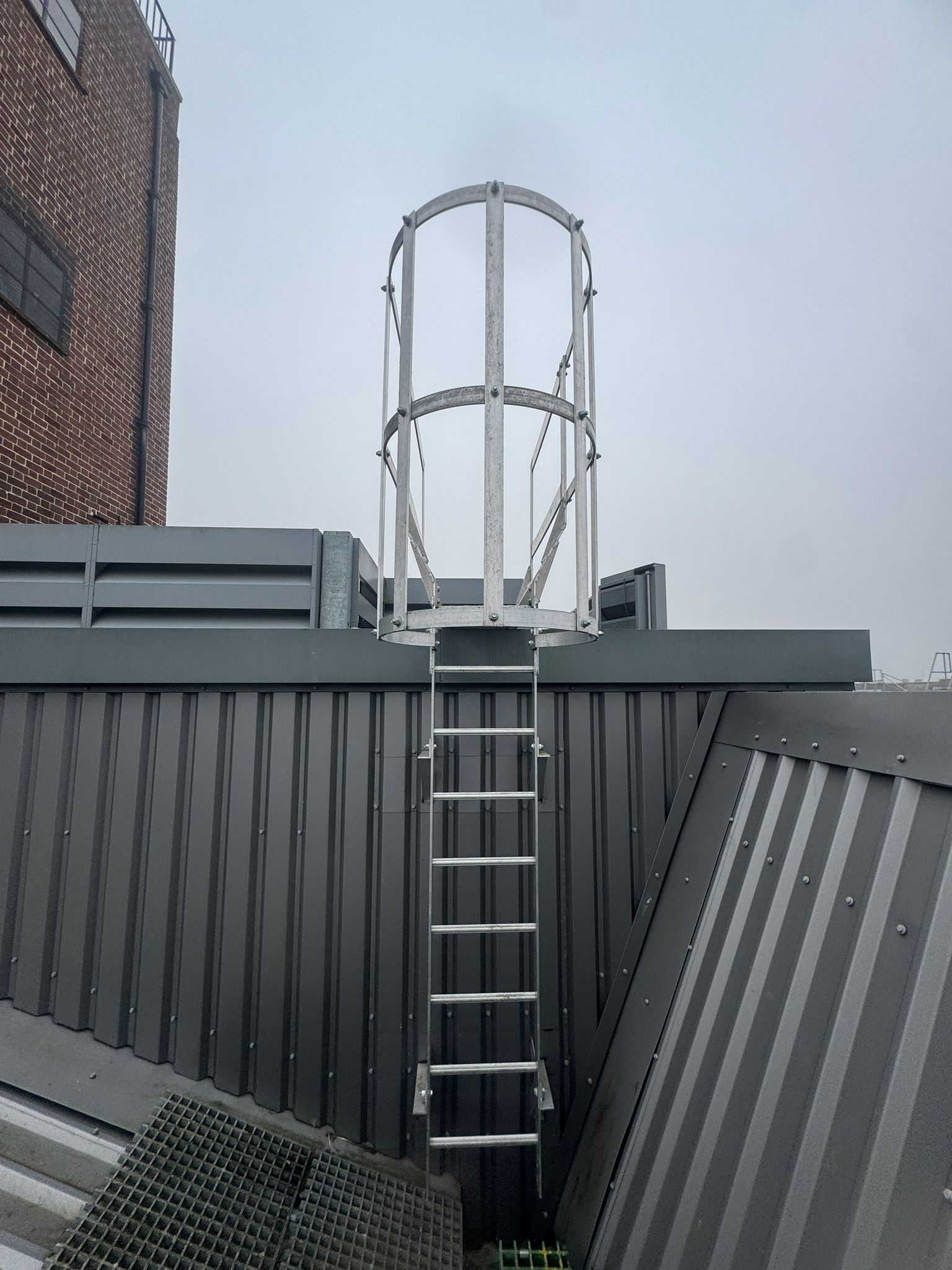
What it is
A fixed access ladder is a permanent vertical, near-vertical, or steeply inclined means of access from one level to another, typically from ground or first-floor level up to a roof, parapet, plant deck, or mezzanine. Unlike portable ladders, fixed ladders are part of the building infrastructure and must be designed, specified, and installed against BS EN ISO 14122-4 for industrial machinery contexts, BS 4211 for fixed ladders to buildings, or BS 5395-1 for steeply inclined ship ladders.
Most fixed vertical access ladders are caged ladders. A caged ladder is fitted with a circular or oval cage that surrounds the climber to prevent outward falls. The cage typically runs from approximately 2.2 metres above the bottom of the ladder up to a point at or above the climb-off level, with longitudinal bars and hoops sized to the relevant standard. Cages remain appropriate for shorter ladders, for replacement installations where the existing structural fixing pattern matches a caged design, and in some contexts — for example public access situations — where personal fall protection equipment cannot reliably be used.
For ladders over 6 metres in height, current HSE guidance moves toward a fall arrest system on the ladder rather than a safety cage. We can specify and install all three vertical configurations — plain vertical, caged, or fall-arrest-equipped — and will recommend the right approach based on the height, use case, and access frequency. We can also undertake repair and remediation of existing caged ladders that have deteriorated or no longer meet current standards, including cage hoop replacement, longitudinal bar repair, and full re-cage of an existing stringer.
A fixed access ladder installation includes the ladder structure itself (rungs, stringers, and any cage or fall arrest system), the top transition platform or hatch arrangement where the ladder meets the upper level, and the bottom anti-climb where required. The installation is engineered against the building’s structural fixing capacity, particularly important for retrofit installations to existing buildings where the wall or facade may need additional reinforcement.
Ship ladders and companionway stairs
A ship ladder (also called a companionway ladder, alternating tread stair, or steep stair) is a fixed inclined ladder at a steeper angle than a conventional staircase but less steep than a vertical ladder, typically 60 to 70 degrees from horizontal. It is the right choice where a conventional stair is not practical due to space constraints but a vertical ladder is not preferred due to the frequency of access or the use of tools.
Ship ladders are installed to BS 5395-1 (stairs, ladders and walkways: design) and BS EN ISO 14122-3 (industrial stairs and step ladders). They include handrails on both sides, slip-resistant treads, and a top landing or transition platform. Common applications include plant deck access, mezzanine floor access in industrial buildings, escape from upper levels in tight buildings, and access to elevated walkways and gantries — particularly in retrofit situations where the existing space cannot accommodate a conventional staircase.
When it applies
- Where existing access is via portable ladder and a permanent solution is required
- Where existing fixed access does not meet current standards and must be replaced
- Where an existing caged ladder has reached end of life or has localised cage failure
- Plant deck or mezzanine access where a conventional stair is not practical and a ship ladder suits the space
- For new plant equipment installations requiring permanent operator access
- Where access to a roof, walkway, or parapet has been identified as a compliance gap
- For new build commercial or industrial buildings
The process
- Site survey. Engineer attends and assesses the access route, mounting structure, angle, and use case.
- Specification and design. Ladder type (plain vertical, caged, fall-arrest-equipped, or inclined ship ladder), height, transition arrangement, and fall protection specified.
- Quotation. Fixed-price quotation covering design, supply, and installation.
- Manufacture. Ladder, cage, treads, handrails, and any fall arrest hardware fabricated to specification.
- Installation. Carried out by our own engineers with full installation certification.
What you receive
- Installation certificate to BS EN ISO 14122-4, BS 4211, or BS 5395-1 (and BS EN 353-1 where a fall arrest rail is fitted)
- Design drawings and load calculations
- Photographic record of installation
- Manufacturer’s product warranty
- 12-monthly inspection cycle to confirm structural integrity, cage condition, slip-resistance, and fixings
- Inclusion in the next annual compliance check at no additional survey cost