
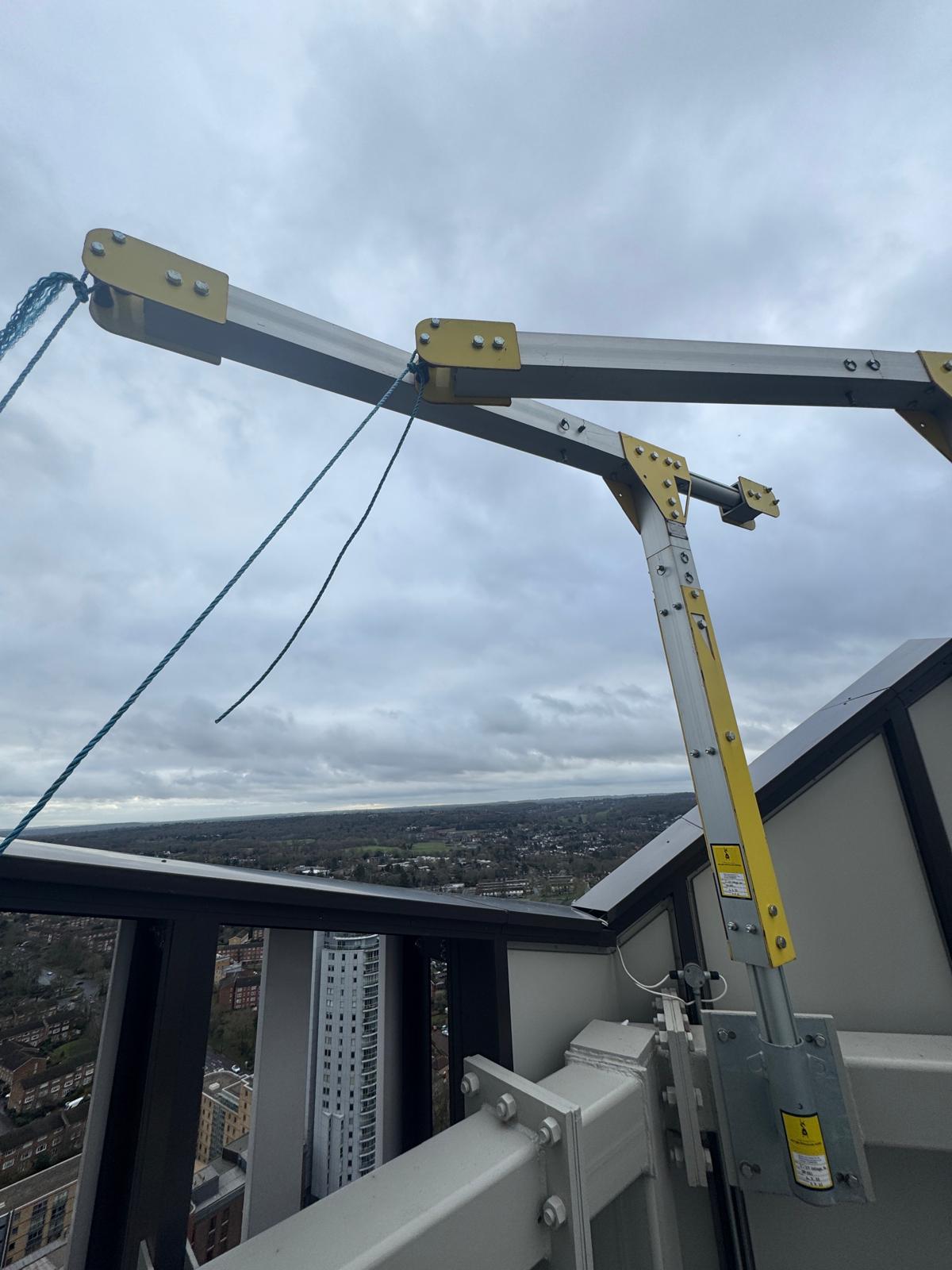
What it is
A davit system is a paired piece of kit: the davit arm itself, and the davit base (the socket, base plate, or counter-balanced mounting) that the arm locates into. The two go hand in hand — neither can be safely used without the other, and a thorough examination has to cover both elements as a single system. Davit systems provide an overhanging anchor point for rope access, facade access, window cleaning, or maintenance abseil work. Because they are used to support the weight of a person at height, they fall under the Lifting Operations and Lifting Equipment Regulations 1998 (LOLER) and require a thorough examination at least every six months by a competent person.
Davit arms are the working arm that extends out over the parapet or facade. They include the arm itself, the head fitting, the pulley or rope-bearing surfaces where present, and any extension, articulation, or rotation mechanism. The arm is a lifting appliance in its own right under LOLER.
Davit bases are the structural mounting that the arm sits in or on. They take the form of either fixed sockets cast or bolted into the building structure, surface-mounted base plates fixed to a parapet or deck, or counter-balanced free-standing bases for situations where structural fixing is not possible. The base is an anchor device in its own right under BS EN 795 and BS 7883:2019, and its condition, fixing, and pull-test record are as critical as the arm itself.
Davit systems are tested against BS 7985 for the rope access context, BS EN 795 for the anchor classification of the base, and LOLER for the lifting capacity of the arm. The inspection covers the arm, every base or socket on site, all welded joints, all moving parts, and the structural fixings around each base. Load testing is performed against the manufacturer’s specification.
Davit systems are often left in place between uses and can suffer from corrosion at the socket interface, particularly on coastal buildings or in industrial atmospheres. Free-standing counter-balanced bases can shift position over time and lose alignment with the parapet. The six-monthly inspection cycle reflects the higher-consequence risk of failure compared to passive anchor systems on a twelve-monthly cycle.
When it applies
- Six-monthly thorough examination of the full system (arm + every base), mandatory under LOLER
- Before each use where the system has been idle for longer than the test interval
- After any incident or damage to either the arm or any base
- On acquisition or change of building ownership
- After structural works to the building affecting any base, socket, or fixing point
The process
- System scope. Every davit arm, every base, every socket, and every supporting component documented.
- Visual inspection. All structural elements, welded joints, fixings, and finishes inspected for damage, corrosion, or wear — on the arm and on every base.
- Function test. Articulation, rotation, and load-bearing tested through the operational range. Arm-to-base location and locking mechanism verified.
- Load test. Performed against manufacturer specification, against BS EN 795 anchor classification for each base, and against the LOLER safe working load for the arm.
- LOLER report. Thorough examination report issued, valid for six months, covering the full system.
What you receive
- LOLER thorough examination report covering the full davit system
- Test certificate to BS 7985 and BS EN 795 for every base
- Socket and fixing inspection record for every davit base on site
- Pairing record showing which arm is approved for which base
- Photographic record of every arm and every base
- Defect or remediation register where applicable
- 6-month recertification reminder