
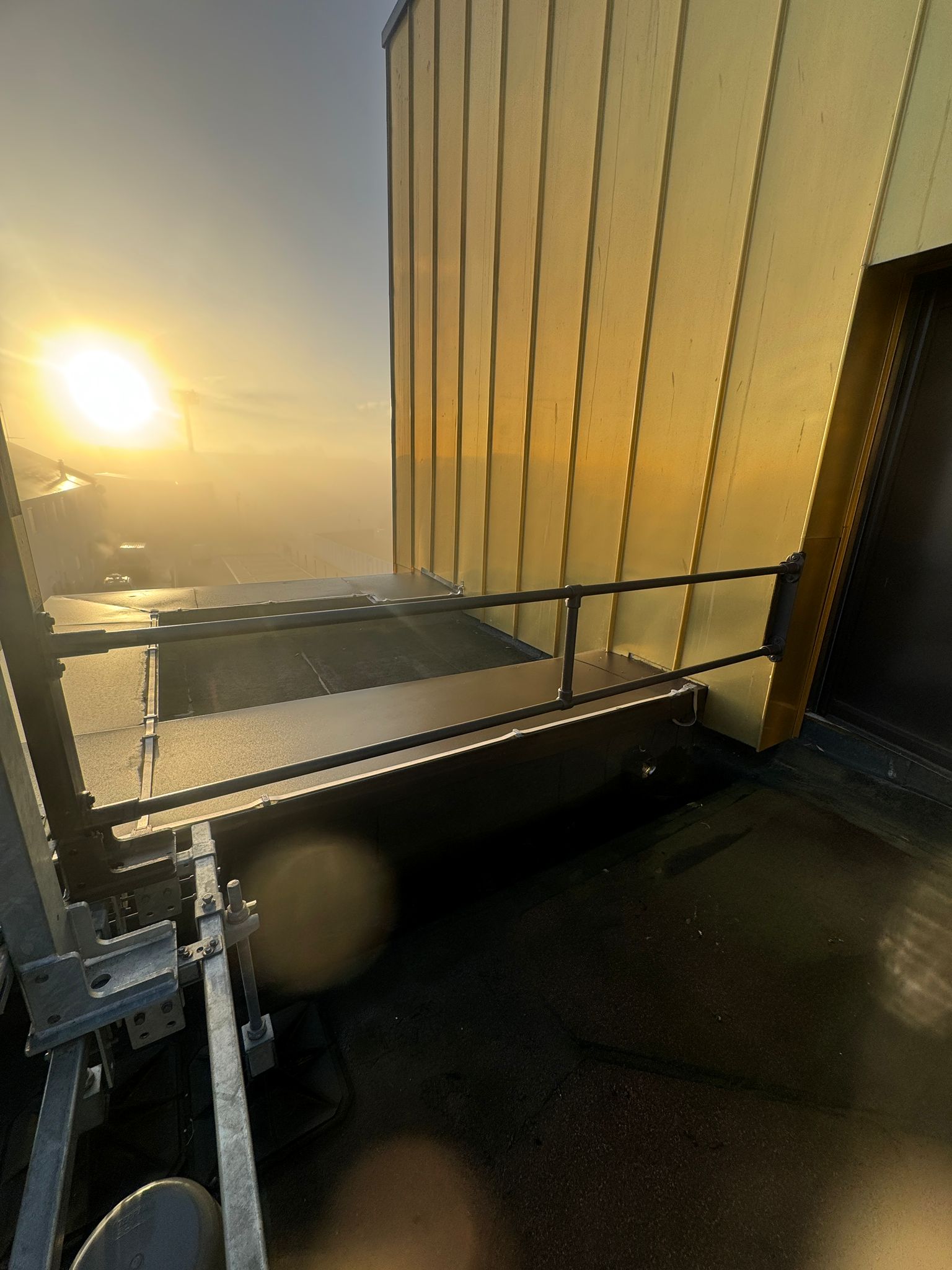
What it is
Guardrails are the primary form of passive collective fall protection on flat and low-pitch roofs. They protect anyone working at height without requiring them to put on a harness, clip on, or remember a procedure. The Work at Height Regulations 2005 establish the hierarchy: collective protection like guardrails comes before personal fall protection like harnesses and anchor lines.
A guardrail system is only effective if it remains structurally sound. Corrosion, impact damage, working loose at the base fixings, and degradation of counterweighted ballast systems are all common findings on roofs that have not been inspected for several years. Our inspection covers free-standing counterweight systems (the most common on flat membrane roofs) and fixed-post systems (more common on parapet edges).
Each inspection is carried out against the standard that applies to the system in front of us. Permanent fixed guardrails are inspected in accordance with BS EN ISO 14122-3:2016, BS EN 13374:2025 and the Work at Height Regulations 2005. Temporary edge protection (Class A) is inspected in accordance with BS EN 13374:2025, BS 13700:2021 and the Work at Height Regulations 2005. The load resistance side of the test is carried out against BS 6180 for both system types. We test the integrity of every section, every joint, every fixing or counterweight, and every gate or removable section. Defects are photographed and logged with their precise location on a roof plan.
The deliverable is a written certification report identifying every guardrail run as pass, repair-and-recertify, or fail. Pass items receive a 12-month certificate. Repair items receive a quotation for remediation. Fail items are flagged immediately with a clear statement of the residual risk so the building manager can restrict access until remediation is complete.
When it applies
- Annual recertification of an existing guardrail system
- After any reported impact, storm event, or maintenance access that involved the rail
- On acquisition or change of building ownership where compliance documentation is being audited
- As part of a wider compliance check covering multiple systems on the same roof
- Following a near-miss or incident involving roof access
The process
- Initial scope. Tell us the roof type, area, system type if known, and last test date. We confirm the visit and bring the correct test equipment.
- Site visit. Engineer attends with full PPE, accesses the roof, and works through every section of guardrail in sequence. Visual inspection, structural integrity check, load resistance check on a sample basis.
- Defect logging. Any defects photographed and logged with location reference on a roof plan.
- Written report. Issued within two working days of the visit. Pass / repair / fail status for every run, with photographs and standards references.
- Certification and reminder. Certified runs receive a 12-month certificate. A reminder is set for the next annual cycle.
What you receive
- Test certificate referencing the applicable standards: BS EN ISO 14122-3:2016 and BS EN 13374:2025 for permanent systems, BS EN 13374:2025 and BS 13700:2021 for temporary Class A systems, and BS 6180 for load testing in both cases
- Annotated roof plan showing every guardrail run and its status
- Photographic evidence of any defects found
- Written pass / repair / fail report
- Fixed-price quotation for any required remediation
- 12-month recertification reminder