
What it is
An abseil anchor is a structural anchor installed at the top of a building or facade specifically to support rope access work below. It is not the same thing as a general-purpose eyebolt: an abseil anchor must support a worker hanging in suspension for the full duration of a descent, must be paired or grouped to provide a redundant secondary anchor, and is used as part of a system rather than as a single fall arrest point.
Because abseil anchors carry a sustained user load under normal use — rather than only an arrest force in the event of a fall — and because failure under suspension is unrecoverable, they are inspected and load-tested at least every six months. This six-monthly interval is shorter than the twelve-monthly cycle applied to general eyebolts, reflecting the higher consequence and higher loading regime of rope access work. The test regime sits across BS EN 795 (anchor device performance), BS 7883:2019 (installation and inspection of structural anchors), and BS 8610 (code of practice for personal fall protection anchor systems and devices used in rope access).
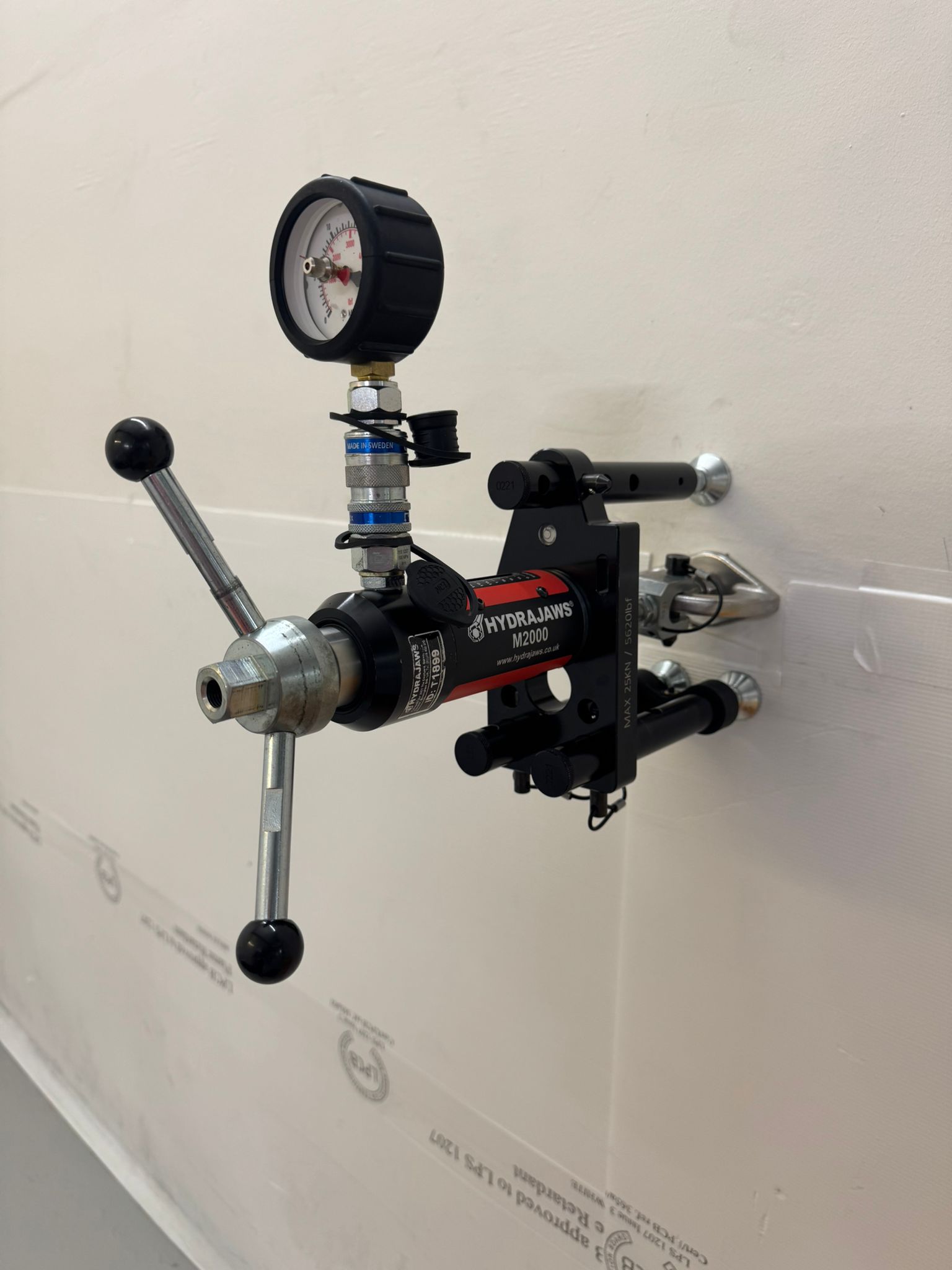
A complete abseil anchor inspection covers the structural fixing, the anchor head, the identification stamping, the paired or grouped configuration that provides the secondary back-up anchor, and the substrate around each fixing. Each anchor is pull-tested against its original installation specification, with the result documented for the inspection record and the building’s anchor register.
Abseil anchors are commonly found on commercial office buildings, hotels, hospitals, and any facade where window cleaning, facade inspection, or facade maintenance is undertaken by industrial rope access rather than by mobile elevating work platform. Where rope access activity is ongoing, the six-monthly inspection cycle is non-negotiable: a missed certificate will pause all rope access work on the building until recertification is complete.
When it applies
- Six-monthly recertification, mandatory for any abseil anchor in active use
- Before any rope access campaign begins, regardless of last test date, where there is doubt about the current certification status
- After any incident involving the anchor or the rope access user
- On acquisition or change of building ownership
- Where existing anchors of unknown provenance are found and rope access work is planned
The process
- Anchor inventory. Every abseil anchor located, counted, paired or grouped against the original install drawing, and documented in the anchor register.
- Identification check. Each anchor checked for permanent identification marking and inclusion in the building’s anchor register.
- Visual inspection. Each anchor and its surrounding substrate inspected for corrosion, cracking, movement, or substrate damage. Anchor head and any rope-bearing surfaces inspected for wear.
- Pull test. Each anchor load-tested against its original installation specification, with the result documented.
- Pairing verification. Each anchor’s paired or grouped secondary anchor verified as compliant — an abseil anchor is only usable in conjunction with a compliant back-up.
- Certification. Compliant anchors receive a 6-month certificate with location reference and pairing reference. Non-compliant anchors flagged for immediate withdrawal from rope access service.
What you receive
- Test certificate to BS EN 795, BS 7883:2019, and BS 8610 for every anchor
- Pull test record with documented load result for each anchor
- Pairing and grouping diagram showing each primary anchor and its back-up
- Annotated facade plan showing every anchor and its status
- Photographic record of every test
- Updated anchor register
- Replacement quotation for any failed anchors
- 6-month recertification reminder