
Book Your Testing, Installation and Recertification Today!
Professional ladder fall arrest system installation services designed to provide safe, compliant access for work at height across commercial and industrial environments.
Fixed ladder fall arrest systems are a critical safety measure where permanent ladders are used to access roofs, plant areas, silos, tanks, mezzanines and service zones. When correctly installed, they provide continuous fall protection for operatives ascending and descending fixed ladders, significantly reducing the risk of serious injury.
We specialise in the installation and certification of ladder fall arrest systems, ensuring each solution is matched to the site, structure and usage requirements.
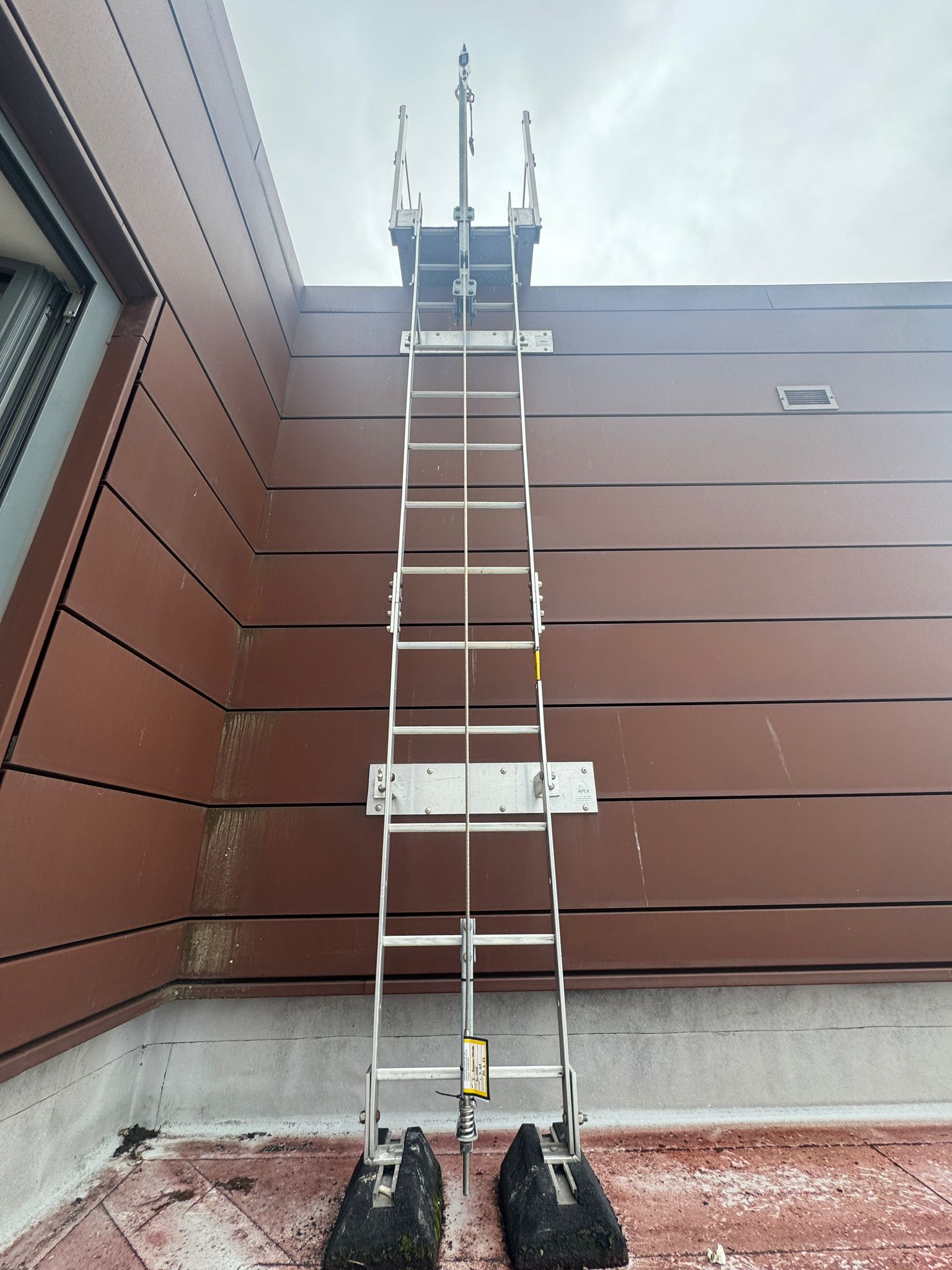
What Is a Ladder Fall Arrest System?
A ladder fall arrest system is a permanent fall protection system installed onto a fixed ladder or supporting structure. It allows users to remain continuously attached while climbing, without restricting movement.
The system typically consists of:
Where access heights exceed 3 metres, installations are completed with appropriate landing or rest platforms in line with regulatory requirements.
Ladder Fall Arrest System Compliance With UK Standards & Regulations
All ladder fall arrest system installations must comply with UK work-at-height legislation and relevant British and European standards.
Our installations support compliance with:
- BS EN 353-1:2014 – Guided type fall arresters on a rigid anchor line
- BS EN 353-2:2002 – Guided type fall arresters on a flexible anchor line
- BS EN 795:2012 Type D – Anchor devices
- BS 7883:2019 – Code of practice for the use, inspection and maintenance of personal fall protection systems
In the event of a slip or fall, the device locks instantly, arresting the fall within a very short distance.
Fixed Ladder Fall Arrest System Installation
Correct installation is essential for a ladder fall arrest system to function safely and meet regulatory requirements.
Our installation service includes:
- Site assessment and access review
- Selection of rail-based or wire-based systems based on ladder type and environment
- Secure fixing to steel, concrete, masonry or existing ladder structures
- Correct alignment and load distribution in line with manufacturer and standard requirements
- Functional testing following installation
We install systems on both new and existing fixed ladders, including vertical ladders fitted to buildings, towers, plant equipment and rooftop access points.
Installation, Inspection & Certification
We provide a complete service beyond installation, ensuring long-term safety and compliance.
Our service includes:
- Professional installation by competent technicians
- Initial testing and commissioning
- Issue of installation documentation and certification
- Ongoing annual inspection and re-certification
- Support with maintenance planning and compliance records
Frequently Asked Questions
When Is Fall Arrest Protection Required?
Fall arrest protection is required when there is a risk of a person falling from height and that risk cannot be eliminated by other means.
In the UK, the Work at Height Regulations require employers and building owners to assess risks and implement suitable control measures. Fixed ladders that are used frequently, extend over significant heights, or provide access to work areas often require a ladder fall arrest system to reduce risk.
As a general rule, if a fixed ladder is used as part of routine maintenance, inspection or servicing activities, fall protection should be provided unless an alternative safer access solution is in place.
A site-specific risk assessment is always recommended to determine the most appropriate level of protection.
What Are the Inspection & Testing Requirements for Ladder Fall Arrest Systems?
Ladder fall arrest systems must be inspected at least once every 12 months by a competent person. Inspections check fixings, rails or wires, fall arrester operation and overall system condition. Inspection records and certification should be kept as part of site safety documentation.
What happens in the event of a fall?
If a fall occurs, the fall arrester locks immediately onto the rail or wire, stopping the fall within a short distance. Shock-absorbing components help reduce impact forces. After any fall, the system must be taken out of service and inspected before reuse.
When is fall arrest protection required?
Fall arrest protection is required when there is a risk of falling from height and the risk cannot be eliminated through safer access methods. Fixed ladders used for routine access, maintenance or inspection commonly require a ladder fall arrest system to meet UK regulations.
What is the difference between rail-based and wire-based systems?
Rail-based systems use a rigid vertical rail with an internal locking device, offering minimal fall distance. Wire-based systems use a tensioned stainless steel cable and guided fall arrester. The most suitable option depends on ladder type, environment and frequency of use.