
Book Your Testing, Installation and Recertification Today!
Caged Ladders & Fixed Roof Access Ladders
Caged ladders provide a stable and controlled means of accessing roofs and elevated areas where permanent vertical access is required. Designed for regular use, they allow personnel to climb safely while maintaining consistent positioning throughout ascent and descent.
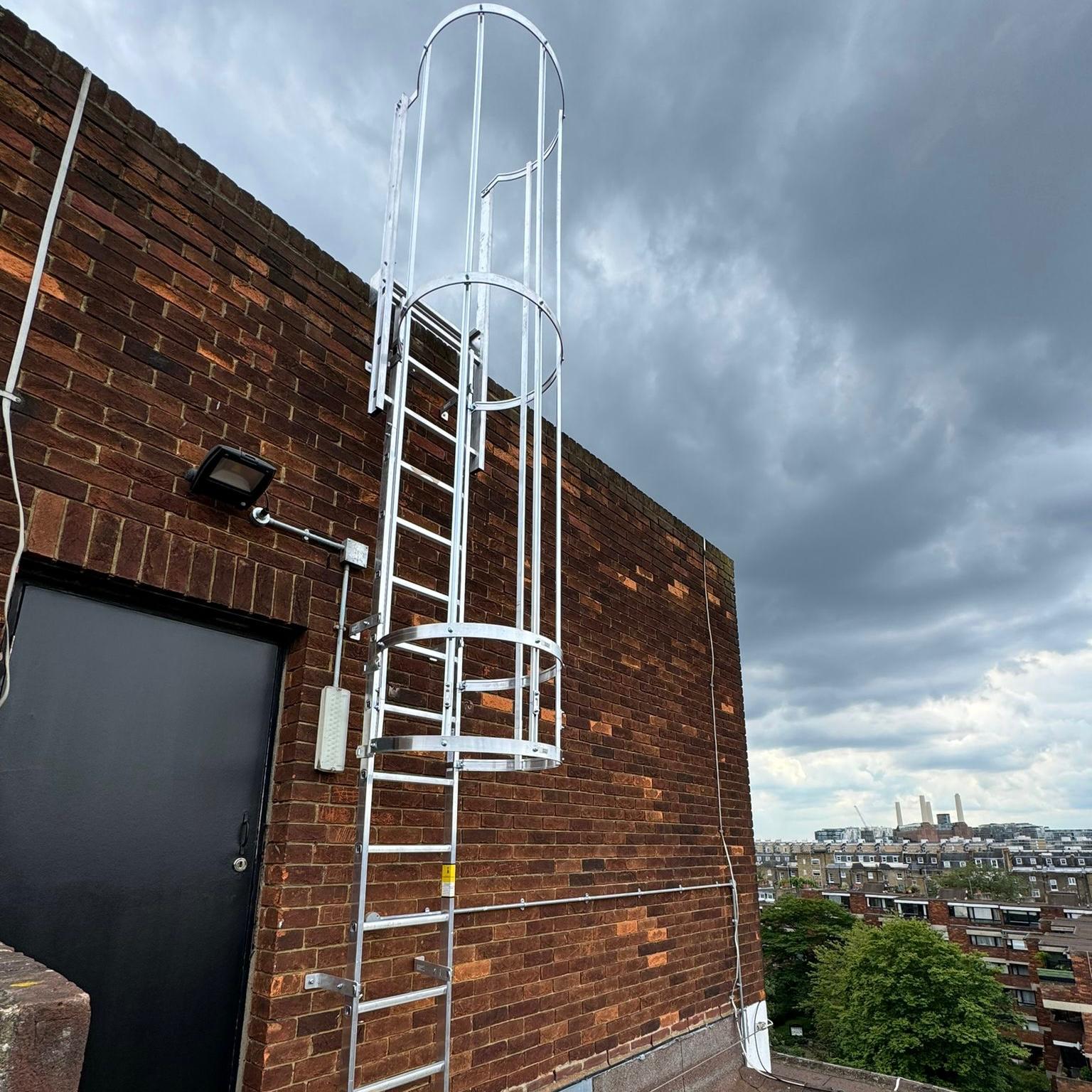
A fixed access ladder fitted with a safety cage offers a practical form of passive fall protection by helping guide the user and reducing the likelihood of backward falls. When installed correctly, caged ladders provide a reliable solution for accessing rooftops, plant areas and service levels across commercial buildings.
In the event of a slip or loss of footing, the surrounding cage helps contain movement and supports the user, making caged ladders a widely adopted access solution where space limitations prevent the use of stairs or inclined ladders.
We install caged and fixed roof access ladders to suit the structure, height and frequency of use of each site, ensuring safe, compliant access that supports ongoing maintenance and inspection activities.
What Is a Caged Ladder?
A caged ladder is a fixed vertical ladder permanently installed to a building or structure and fitted with a surrounding safety cage. The cage is designed to provide passive fall protection by restricting backward movement and helping guide the user during ascent and descent.
Caged ladders are commonly used where:
- Access heights exceed 3 metres
- Ladders are used frequently by maintenance teams or contractors
- Permanent roof or plant access is required
- Space constraints prevent the use of stairs or companionway ladders
They are widely used across commercial, industrial and public-sector buildings.
When Are Caged Ladders Required?
Caged ladders are typically specified when a fixed ladder exceeds 3 metres in height and is used as a regular means of access. In these situations, additional protection is required to reduce fall risk and improve user safety.
While safety cages provide basic fall protection, current best practice increasingly considers whether ladder fall arrest systems may be required instead of, or in addition to, a cage. We can advise on the most appropriate solution based on risk assessment and site usage.
Caged Ladder - Compliance With UK Standards & Regulations
All caged ladders and fixed access ladders must comply with relevant UK legislation and British Standards.
Our installations support compliance with:
- BS 4211:2005 – Specification for permanently fixed ladders
- BS EN ISO 14122-4:2016 – Permanent means of access to machinery
- PUWER 1998 – Provision and Use of Work Equipment Regulations
We ensure each installation meets the required dimensional, fixing and safety criteria and is suitable for its intended use.
Key Benefits of Caged & Fixed Vertical Ladders
- Permanent, secure access to roofs and elevated areas
- Suitable for frequent internal and external use
- Space-efficient vertical design
- Compatible with additional safety and security features
- Robust, long-lasting construction
- Can be integrated into wider access and fall protection strategies
Typical Applications for Caged Access Ladders
Caged ladders are commonly installed in:
- Commercial office buildings
- Warehouses and distribution centres
- Hospitals and healthcare facilities
- Universities and education campuses
- Retail and hospitality buildings
- Industrial plants and plant rooms
They are frequently used for roof access, rooftop plant servicing, façade maintenance and access between split roof levels.
Frequently Asked Questions
When do you need a fixed ladder with a safety cage?
Fixed ladders typically require a safety cage when they exceed 3 metres in height and are used as a regular means of access.
Where are caged access ladders most commonly used?
They are commonly used for roof access, plant servicing, maintenance routes and access between different roof levels in commercial and industrial buildings.
Are caged ladders still compliant with UK regulations?
Yes, when designed, installed and maintained correctly. However, risk assessments may identify ladder fall arrest systems as a safer alternative in some situations.
How often do caged ladders need to be inspected?
Caged ladders must be inspected at least every 12 months by a competent person in line with PUWER regulations.
Can caged ladders be retrofitted to existing buildings?
Yes. Most caged ladders can be installed onto existing structures, subject to a structural assessment.